
 look book

latest
habitat tv

Say goodbye to the morning scramble for keys, coats and sunglasses and hello to this… see this and more videos
blog

Reader roundup: See what our readers have been up to!
Refurbished vintage furniture, charming exteriors and magnet walls for kids. These projects are sure to… more
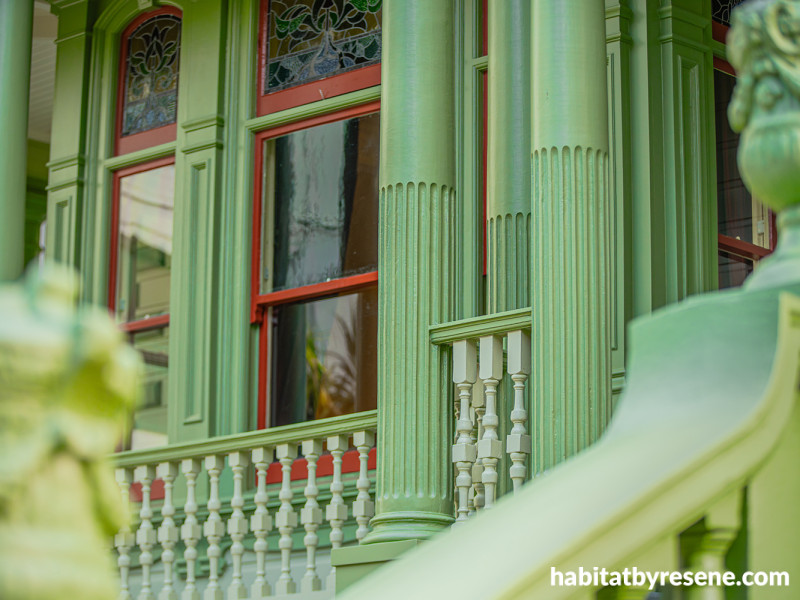
A new chapter for Antrim House
04 Dec 2025
Antrim House has always stood out. Burrowed among the contemporary high-rises of central Wellington, this grand timber building is a rare reminder of the capital’s architectural past. Designed by Thomas Turnbull & Son and completed in 1905 as the residence of prominent footwear entrepreneur Robert Hannah, Antrim House is a Category 1 historic place, and the current national office of Heritage New Zealand Pouhere Taonga (HNZPT).
This grand Edwardian beauty now has her glow back with help of Resene paints and heritage-focused care.
While the bones of the building have been lovingly maintained over the decades, its exterior had started to show signs of wear from Wellington’s famously punishing weather. That called for a careful restoration, one that respected the past while giving the house a lighter, fresher new look.
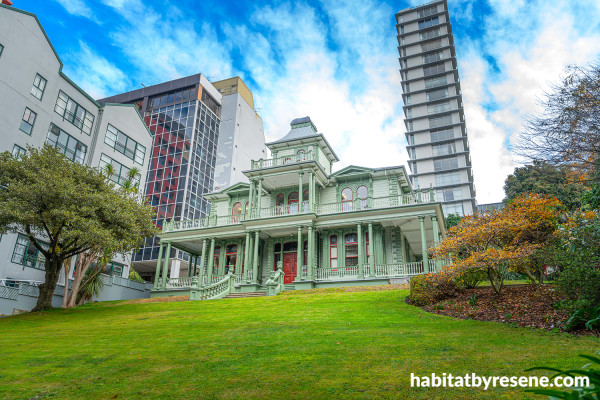
Standing out amongst the high-rises in Wellington, Antrim House is painted in Resene Bud, Paddock, Double Rice Cake and Burnt Sienna. Image by Brayden Mitchell.
“Although constructed of first-class native and exotic timbers and lovingly cared for by the nation’s preeminent historic heritage agency for four decades, staff and leadership recognised that significant investment would need to be made to maintain weathertightness and allow the exterior architecture to ‘pop’,” says Jamie Jacobs of Heritage New Zealand Pouhere Taonga (HNZPT).
The restoration was completed in two phases between October 2022 and May 2024. A new roof and seismic strengthening kicked off the process, followed by a full exterior restoration including a painstaking strip, scrape, timber repair and repaint. Remarkably, Jamie notes that scorch marks found during the process suggest that the house hadn’t been fully stripped since around 1905.
“For buildings like Antrim House, resplendent with beautiful timber architectural detail, a full strip fully reveals the sharp intricacy of the timber carving and moulding and allows the building’s aesthetic qualities to be entirely appreciated,” Jamie says.
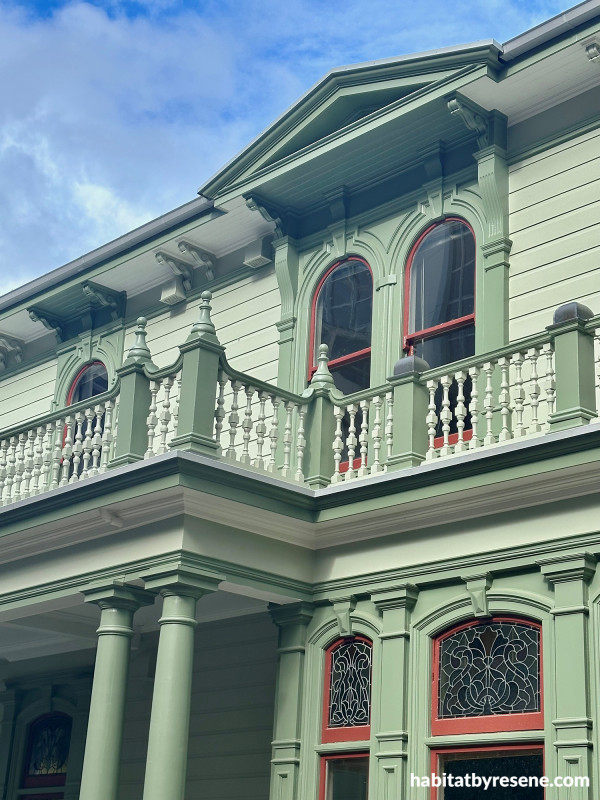
Antrim House is now refreshed with uplifting greens. The weatherboards are painted in Resene Bud, with darker green detailing in Paddock. Soffits and veranda roofs are painted in Double Rice Cake and window sashes in Burnt Sienna.
The previous palette was formal and subdued. Greys and deep reds that made the house feel a little too ‘serious’. This time, the brief was different. The team wanted colour – something warmer, more inviting, and a bit more joyful.
HNZPT collaborated with the Resene team to develop three potential heritage-appropriate palettes. The final choice brought together soft green hues with bright, grounding accents.
Resene Bud, a soft natural green, was chosen for the weatherboards, while a slightly darker pastoral green, Paddock, was used for columns, window cases and trims. Double Rice Cake brightened soffits and veranda roofs and Burnt Sienna, a deep, earthy red, now adorns the window sashes and doors.
“The orange tinge of Resene Burnt Sienna provides a lift to the window joinery and doors and pleasing instances of contrast with the greens,” Jamie says. “Resene Double Rice Cake then lightened areas in shadow.”
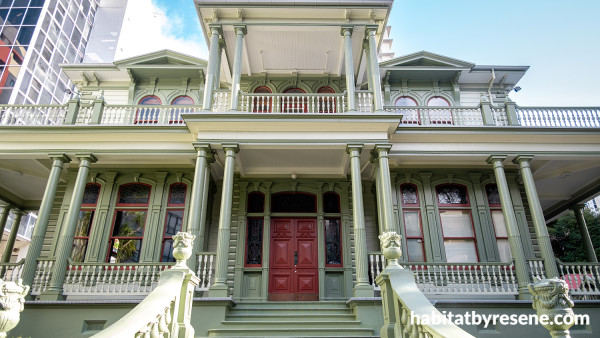
The deep red of Resene Burnt Sienna on doors and window sashes contrast beautifully with Bud and Paddock on the exterior and Mountain Mist on the veranda deck. Image by Brayden Mitchell.
Products were chosen as carefully as the colours themselves, with each finish tailored to the demands of the building’s materials and location. Resene Sonyx 101 gave the weatherboards a moderate sheen, Resene Lumbersider was used on soffits for a lower sheen, Resene Lustacryl handled the joinery and Resene Paving Paint in Resene Mountain Mist refreshed the veranda deck.
With a building of this age and calibre, preservation is about precision. The timber, mostly totara, matai and jarrah, was in remarkably good condition, so the focus was on repair rather than replacement. Instead of removing large sections, around 600 traditional wooden “bowties” were used to bridge cracks and splits, a technique more often used in furniture making.
“Perhaps unsurprisingly, most of the intensive repair work occurred on the 29 veranda columns, which are most exposed to the elements,” Jamie says. “Many of the top and bottom blocks made of jarrah were recrafted.”
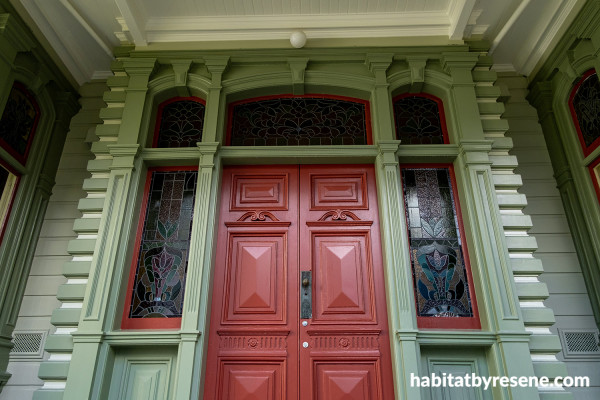
The front doors are painted in the bold Resene Burnt Sienna, a hue that pays homage to the history of the building. The weatherboards are painted in Bud, columns, window cases and trims in Paddock and soffits and roof in Double Rice Cake. Image by Brayden Mitchell.
Small but smart details, like lead-look stainless steel flashings over window frames and column tops, painted to blend seamlessly, were added to support weathertightness and durability without compromising the home’s character.
Every decision in this project was made with the building’s significance front of mind. As Jamie puts it, “the fundamental conservation principle in carrying out remedial work to old buildings is ‘as much as necessary, but as little as possible’.”
That restraint paid off. Antrim House now gleams with its original splendour, showing off crisp architectural lines, vibrant yet timeless colour, and timber detailing not seen this clearly in decades.
It’s a fitting tribute to a building that has housed stories for over a century, and is now ready to carry many more.
design and colour Heritage New Zealand Pouhere Taonga
specifierR&D Architects Ltd, Conservation Architects
painting JPB Painting Contractors Ltd
images Brayden Mitchell and Jamie Jacobs
Tip: If you have an older character build or project you’re working on and want to be more classic in your approach to the colour scheme, check out the Resene Heritage colour palette at your local Resene ColorShop or reseller, or see it online at www.resene.com/heritage.
Published: 04 Dec 2025