
 look book

latest
habitat tv

Say goodbye to the morning scramble for keys, coats and sunglasses and hello to this… see this and more videos
blog
Reader roundup: Public murals and powder blues
A Morningside mural, an exterior refresh, and striped walls. Let these projects be your inspiration… more
Forget Cloud Dancer, Resene All Black is where it’s at
10 Mar 2026
It is a commonly held opinion that the durability of paint systems declines the darker the chosen colour. While there is some validity to this notion, significant testing by Resene shows that the correlation is not as straightforward as believed.
To better understand the relationship between colour and durability one has to look at three separate factors: pigment durability; paint film durability; and substrate durability.
Durability of the pigment
The OG pigments were crushed natural ores that are, by nature, highly stable. Surviving examples of pre-historic petroglyphs using natural ochres are testament to their durability. However, as a general rule, these natural ores produce only muted colours.
The first synthetic organic pigments, while colourful, were fairly simple molecules that were easy to synthesise. Unfortunately, molecules that are simple to put together are often equally easy to knock apart, that is they lack durability.
Ongoing research and development into synthetic organic pigments, such as that carried out by Resene, means increasingly more complex and stable organic pigments have been synthesised resulting in a full range of highly stable, brightly coloured pigments, the durability of which can be reliably measured.
Durability of the paint film
Most oil-based films are characterised by being ‘thermo-set’, that is they cure and harden with the application of heat. However, this hardening is a continual process over time, resulting in embrittlement and loss of flexibility. Therefore, in colours that absorb a lot of heat, this process can be accelerated, leading to an speedier breakdown of oil-based films. It is this phenomenon that led to the aforementioned opinion.
It was also the catalyst for the development of waterborne paints by Resene in 1951.
If the vehicles used to make paint are either passive- or resistant-to heat, then this rule no longer holds, which is why acrylic vehicles, known to be passive to heat, can be formulated so that a dark chrome green is more durable than a white. A similar situation exists when using heat-resistant silicone alkyds.
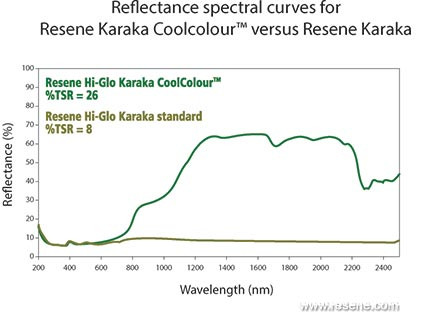
Comparison testing of Hi-Glo Karaka CoolColour vs the standard Hi-Glo Karaka product shows the IR-reflecting capability of the CoolColour version, which resulted in a 12ºC variance in surface temperature.
Durability of the substrate
On a fine summer’s day, with an air temperature of around 20°C, the surface temperature of white paint will vary minimally to that of the ambient temperature; a dark paint, however, can achieve a surface temperature of up to 70°C.
Temperatures this extreme have been shown to have a detrimental effect on unstable substrates. For example, they can change the equilibrium moisture content (EMC) of timber, resulting in splitting and cupping or cause formerly stable resins to leach out of the wood. They can also cause the breakdown of any underlying oil-based paint layers.
Such failures are often mis-attributed to a lack of durability of dark paints, when in actuality, the problem comes down to the lack of heat resistance of the substrate.
Which is where Resene’s pioneering technology, CoolColour, comes to the fore. Following on from research into heat-resistant pigments in the ceramics industry, Resene scientists incorporated heat-resistant, or infra-red reflecting, pigments into a high-gloss roof product tinted to Karaka.
Testing proved that the IR-reflecting CoolColour variant registered a full 12ºC cooler than the traditional roofing product. That 12°C shift is enough to make a tremendous difference to the stresses exerted on a substrate, effecting both its heat gain propensity and overall stability.
Thanks to the efforts into colour development and longevity by Resene’s colour team, dark colours per se are no barrier to durability if the pigment is carefully selected by chemical type, the binder is resistant to heat, and the substrate is stable at the surface temperatures expected.
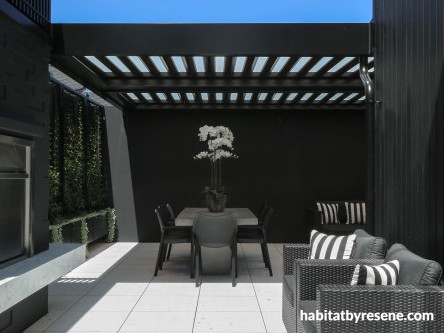
Main image: Taking advantage of Resene’s CoolColour technology, this striking, monochromatic patio features walls painted in All Black (rear and left) and ColorWood Pitch Black.
Published: 10 Mar 2026