
 look book

latest
habitat tv

Say goodbye to the morning scramble for keys, coats and sunglasses and hello to this… see this and more videos
blog
Reader roundup: Public murals and powder blues
A Morningside mural, an exterior refresh, and striped walls. Let these projects be your inspiration… more
Heart of glass… and concrete
21 Jan 2026
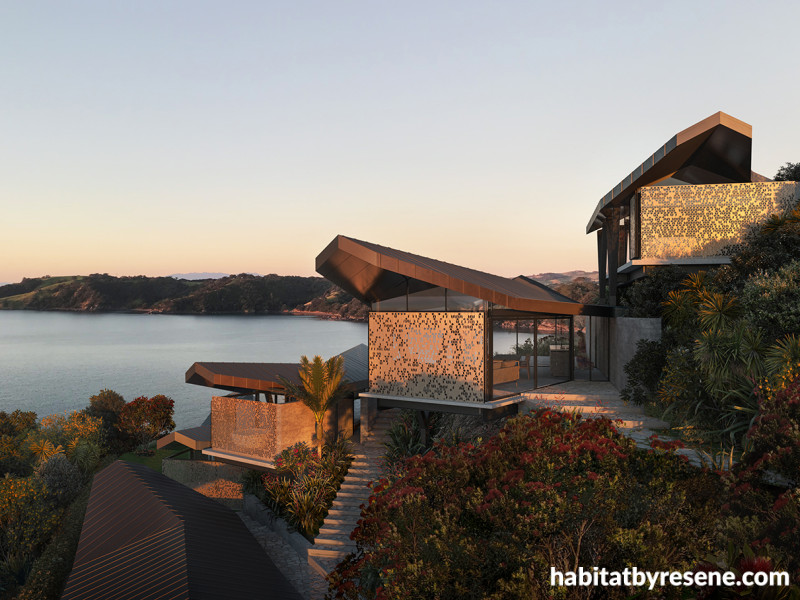
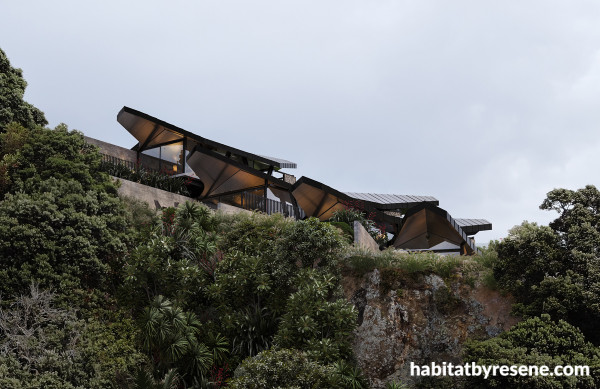
On a steeply sloped and rugged ridgeline on Auckland’s Waiheke Island emerges a series of structures that appear at the same time to be anchored in place yet floating free.
“I am interested in architecture that is experienced as much emotionally as it is practically,” says architect Michael Pepper. “My aim is to create expressive, sculpted forms that delight the senses and amplify the unique qualities of each site.”
For this site – which incorporates gradients of 19 degrees to 25 degrees and has a district plan control restricting building height above the ridgeline – answering the clients’ brief for a home that maximised the views while incorporating a mix of private and shared spaces that could be activated as needed, was going to take some non-linear thinking.
The ROCKCOTE Resene masonry overlay system includes a layer of 50mm XTHERM insulation board fixed against the solid masonry structure, with a lamina of hand-applied, modified plaster coatings that can be styled in your choice of textures and finished with Resene protective coatings in your favourite Resene colours.
“It took some finessing, but we were able to answer the brief and work with the topographical demands by stepping the building volumes down the site in three-metre increments. This meant that each building volume was able to look over the roof of the volume below.
“In doing so, we were able to kind of cluster the building volumes, much like a tiny Italian village perched on a hillside, in a way that kept our roof heights under the four-metre control limit, kept our cuts less than two metres, and enabled us to create a kind of an elastic building with separate sleeping zones and then a central living/dining area, which is a more communal space,” says Michael.
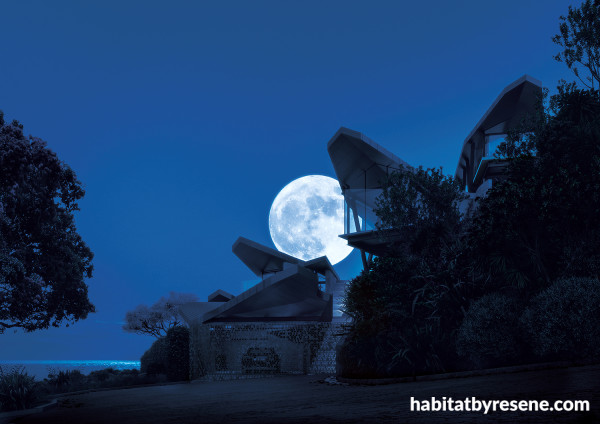
Both ethereal and tangible, this home by Michael Pepper Architects revels in its rugged Waiheke Island setting.
With the form of the building locked in, materiality was the next key consideration. Given the expansive vistas on offer, glazing was going to account for a large percentage of the buildings’ surface area. This meant any other materials needed to do double duty in terms of aesthetics and performance.
“Essentially, there're only three components to this building; the roof, the walls – glazed and solid – and the floors,” says Michael. “With the amount of glazing, one of the concerns was with regulating the internal environment.
“To the rear of each volume a stratified concrete wall anchors the floating roof plane to the ground. I very much wanted to emulate that look on the exterior and so I chose the ROCKCOTE Resene masonry overlay system for the exterior and the underside of the cantilevered floors.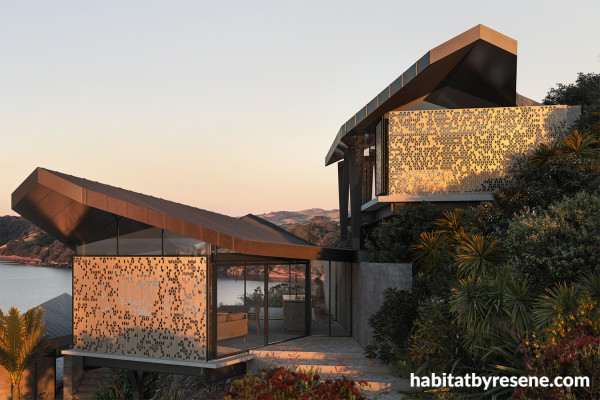
TheROCKCOTE Resene masonry overlay system was applied to the underside of the cantilevered floors and to the exterior of the stratified concrete walls to provide external insulation designed to maintain comfortable internal temperature and humidity levels.
“This ensured the concrete floors and rear walls would act as a thermal mass to even out fluctuations in indoor temperature and humidity. During this whole process I looked at lots of different products but I kept coming back to the ROCKCOTE Resene masonry overlay system as it was the ideal solution to solve the building science issue – insulation of the thermal mass from the exterior – as well as solving the aesthetic issue – how to create a low-maintenance, monolithic finish to the exterior that matched the interior stratified concrete finish. Both myself and the clients couldn’t be happier with the result.”
Images: #wiak studio
Published: 21 Jan 2026